
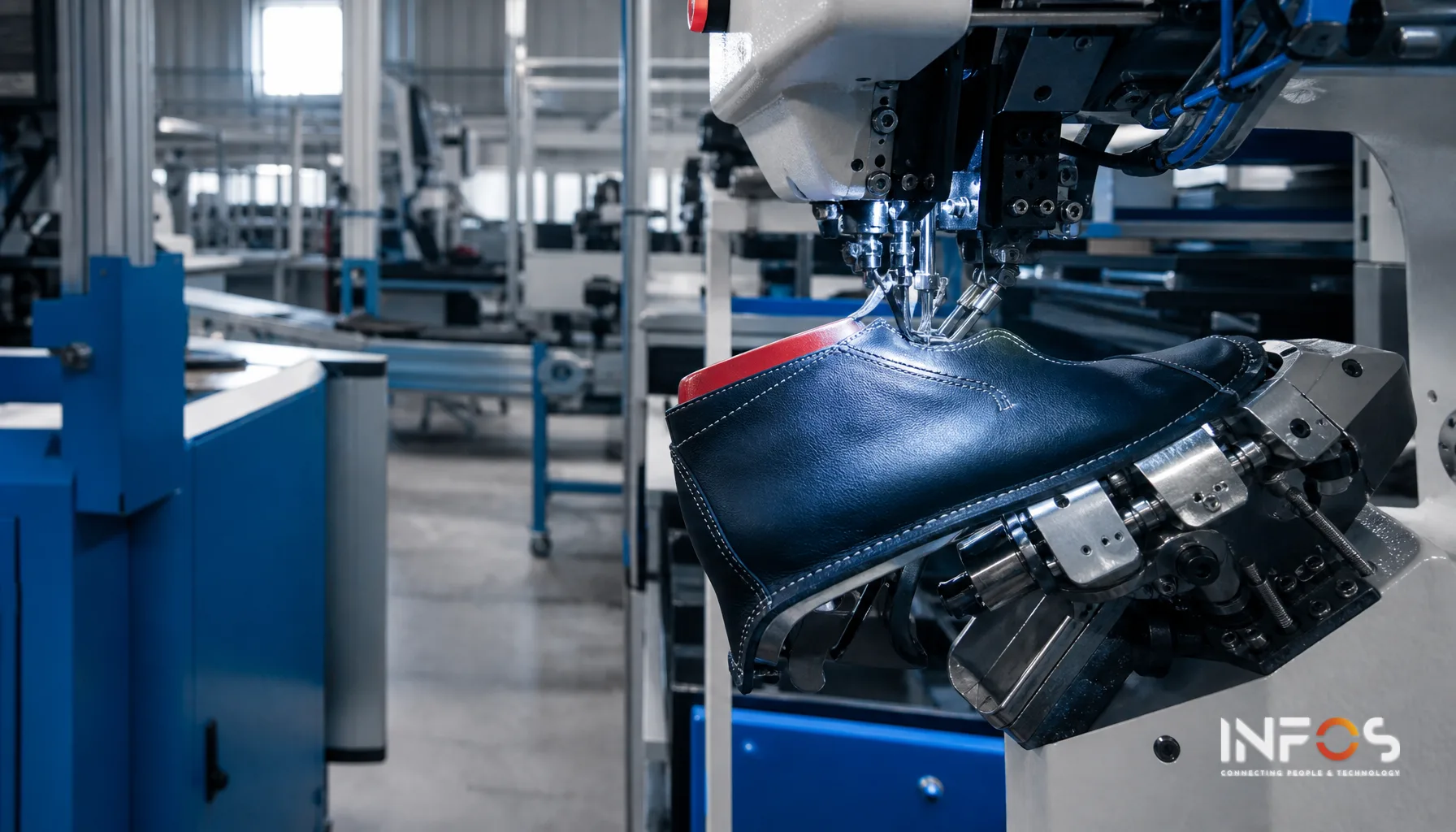
A collection of women's footwear samples in Felgueiras has between 800 and 1,200 SKUs, three axes — colour, size, last — and a calendar that shows no mercy: the international buyer lands in February and August, sees everything in two days, and decides. If your ERP does not model colour-size-last in a single record, you are managing the collection in Excel. And Excel does not do batch-by-batch traceability — it makes you a promise it breaks at the brand's first audit.
The thesis, plainly: in footwear, the problem is not the shop floor. It is development. Most factories lose margin before the first sole is cut — in the loss of control over the technical sheet, the consumption sheets, the sample versions that no one can reconcile when the production order comes in. A generalist ERP solves series production. It does not solve the 1,200 samples that precede it. This text shows how to audit production control from development through to delivery, with a matrix you can take into tomorrow's meeting.
What you need before you start
Do not open the specification without these six things on the table. The audit always fails in the same place: someone wants to discuss the ERP in the abstract, without a real collection in front of them. Without concrete numbers, the conversation turns into sales folklore.
- A real collection in hand, with an exact SKU count per colour-size-last axis.
- The technical sheet for at least one model, with a complete Bill of Materials.
- Current operation times — cutting, stitching, lasting, finishing — even if estimated by eye.
- The list of subcontractors and what each one performs: skiving, uppers, soles.
- The development manager and the production supervisor available to validate (do not delegate validation to someone who does not cut leather).
- The last three traceability requests a brand has made of you, under the ESPR.
- Access to the current system to export real consumption and stock figures — not theoretical ones.
Step 1 — Model the colour-size-last axis in one record, not three
This is where the vertical ERP separates from the generalist. A footwear model is not an item — it is a matrix. The same reference exists in 6 colours, 14 sizes and 2 lasts. That is 168 combinations of a single model. Multiply by a collection of 300 models and you reach more than 50,000 combinations. Now you see why Excel collapses and why the pattern maker keeps half of it in their head.
Check whether the system represents this cardinality natively. If you have to create 168 manual items for one model, maintaining the collection becomes impractical — and consumption errors enter precisely there, in the difference between the SKU that exists on the sheet and the one that exists in the head of whoever is cutting. The MULTI ERP handles footwear verticals on a common core, with the axis matrix as its foundational structure.
- Confirm: one model = one record, with a colour × size × last grid.
- Confirm: consumption per pair calculated from the grid, not keyed in by hand.
- Confirm: a change to the size scale propagates to all affected SKUs without manual rework.
Step 2 — Link the development sheet to real material consumption
This is where invisible money is lost. The sample consumes leather that no one recorded against the sheet. The pattern maker cuts, tests, cuts again, changes the toe shape and cuts once more. Three weeks pass and the factory does not know how much it cost to develop that model — it only knows that the roll of €38/m² leather ran out faster than it should have, and that the owner frowned in the month-end meeting.
Link every sample consumption to the technical sheet from the first cut. That way, when the series order comes in, the consumption sheet is already validated with real data — and not with the optimistic estimates the sales rep used to close the price. This link is what delivers measurable ROI in development, the phase almost no one measures because it is hard to measure without the system closing the loop. Development cost per model stops being an accounting mystery and becomes a number you read in Qlik Sense.
Step 3 — Plan the series with subcontracting dependencies
In the Felgueiras–Guimarães corridor, few factories do everything in house. The uppers go out, the soles come from a supplier, the stitching may be split between two workshops in different villages. The real Cycle Time of the order depends on links you do not directly control — and the stitching subcontractor also works for the neighbour, who also has an August deadline.
Planning has to include the subcontractors' windows as constraints, not as footnotes written in pencil. Planning with finite capacity and APS helps, but it is only worth it if the operation data is real. Here, shop-floor capture with KORA Productivity closes the loop: it feeds the planning with times observed at the terminal, instead of manual times no one has met since 2015.
Step 4 — Close the loop with batch-by-batch traceability through to dispatch
The European product ecodesign regulation (ESPR) has been in force since July 2024 and has raised traceability requirements — that is the European Commission saying it, not a software vendor. When one of the parent brands that subcontract in the North asks for the origin of the leather batch that went into that pair, the answer cannot take three days and involve four people leafing through paper delivery notes in a filing chest.
Batch-by-batch traceability from raw material must be in the ERP's structure, not stuck on top with an add-on. Check whether, from a dispatched pair, you can reconstruct backwards: leather batch, sole batch, stitching workshop, lasting date and shift. If any of these links lives on a separate sheet, the chain breaks at the link that is on holiday.
Decision matrix: what a footwear ERP has to do
| Criterion | Generalist ERP | Footwear vertical ERP |
|---|---|---|
| Colour-size-last axis in one record | Manual items per combination | Native matrix |
| Sample consumption linked to the sheet | Separate record | Integrated into development |
| Subcontracting as a planning constraint | Manual note | Modelled in the planning |
| Batch-by-batch traceability | Add-on or paper | Built in from the start |
| AT/SAF-T pt-PT compliance | External configuration | Designed in from the start |
| Manageable collection of 1,000+ SKUs | Degrades quickly | Foundational structure |
In footwear, whoever controls development controls the margin. The series is just the execution of decisions already taken on the technical sheet.
Common mistakes and how to avoid them
- Managing the collection in Excel parallel to the ERP. Demand that the system models the axis matrix; if it does not, Excel is the symptom, not the cause. The file survives because the ERP fails, not the other way round.
- Estimating consumption by manual instead of real capture. Link production to the ERP with shop-floor terminals and validate sheets with observed data over at least one complete collection.
- Treating subcontractors as material suppliers. Model them as operations with their own capacity and window in the planning — because a workshop that delays the stitching delays the dispatch, not the other way round.
- Leaving traceability until the brand asks. Record batches at raw material receipt, not at dispatch — at dispatch it is already too late and the leather batch has already been consumed by three different orders.
- Buying by feature checklist without a proof of concept with your collection. Test with a real model of 168 SKUs before signing. See how to assess the vertical fit before signing a contract.
The context that changes the urgency
The Portuguese footwear industry exported 1,718 million euros in 2025, around 68 million pairs, with sales to European markets growing 3.3% (to €1,420M) while the United States fell 12.3% (to €84M), according to APICCAPS. Read what these numbers say: the margin is in the value of a fast response to the European buyer, not in the cheap volume Asia does better. With the US in decline, the European market is where the game is played — and the European buyer is precisely the one who brings the ESPR under their arm.
Whoever answers a traceability request in minutes, and not in days, keeps the order. It is the same principle we defend for control over the entire textile value chain and for scaling an industrial SME.
A detail that only shows up on the ground, and that no ERP manual admits: the factory's IT hero — 15 years of business knowledge, no degree, indispensable and therefore dangerous — keeps the consumption sheets in their head and in a file only they can decipher. When a well-implemented vertical ERP captures that knowledge in structure, the factory stops depending on one person who one day leaves, falls ill, or asks for a raise because they know no one can replace them. It is the most underestimated step of any rollout, and the one that generates the most resistance — because it takes power away from whoever holds it. It is worth deciding to face it head-on, with the man himself in the room, and not behind his back. To turn that data into decisions, a layer of real-time BI with Qlik Sense closes the loop from development to delivery.
The next step
Take a real model from your next collection, count the SKUs across the three axes, and test whether your current system represents it in one record or in 168 manual items. That count is the most honest diagnosis you can make this week — and it costs nothing beyond half an hour and the courage to look at the number.
Sources
- APICCAPS — Portuguese Association of Footwear, Components and Leather Goods Manufacturers. Footwear export data 2025 (February 2026).
- European Commission — Regulation (EU) 2024/1781, Ecodesign for Sustainable Products Regulation (ESPR), in force since July 2024.
Frequently asked questions
What is a SKU in the footwear context and why does it matter for production control?
A SKU (Stock Keeping Unit) is the individual reference unit — a specific combination of model, colour, size and last. A collection of 300 models in 6 colours, 14 sizes and 2 lasts generates 50,000 SKUs. Without modelling this natively in the ERP, traceability is lost and management collapses into Excel, compromising margins before production even begins.
Why does footwear development cost more than it seems?
The pattern maker cuts, tests and rejects samples without recording consumption against the technical sheet. Weeks of iterations consume invisible leather and time. When the order comes in, the consumption sheet is an optimistic estimate, not real data. Linking every sample consumption to the sheet from the first cut reveals the real cost and avoids negative margins on the series.
How does the batch-by-batch traceability required by the ESPR work?
The European ecodesign regulation (ESPR, in force since July 2024) requires reconstructing the origin of each pair: leather batch, sole batch, stitching workshop, date and shift. This must be integrated into the ERP from raw material receipt, not stuck on afterwards. If one link lives on a separate sheet, the chain breaks at the audit.
What is the difference between a generalist ERP and a vertical ERP for footwear?
A generalist ERP forces you to create 168 manual items for one model (6 colours × 14 sizes × 2 lasts). A vertical ERP models the colour-size-last matrix in a single record, with consumption calculated automatically. Maintenance becomes practical and consumption errors disappear because the SKU on the sheet matches what the cutter sees.
How should planning account for subcontracting in Felgueiras?
Few factories do everything in house — uppers, soles and stitching go out to subcontractors who also work for competitors. Planning with finite capacity (APS) has to include the subcontractors' windows as constraints, not footnotes. Real operation data from the shop floor feeds this planning with observed times, not manual estimates.
What is the axis matrix and why is it critical for production control?
The axis matrix (colour × size × last) is the foundational structure that represents all combinations of a model in a single record. Without it, the collection fragments into hundreds of manual records and the pattern maker keeps half the logic in their head. With the native matrix, size scale changes propagate automatically to all affected SKUs.
What concrete data do I need to gather before auditing production control?
A real collection with an exact SKU count, a complete technical sheet with Bill of Materials, current operation times (cutting, stitching, lasting, finishing), a list of subcontractors, the development manager and production supervisor available to validate, the last three brand traceability requests, and access to the system to export real consumption and stock figures.